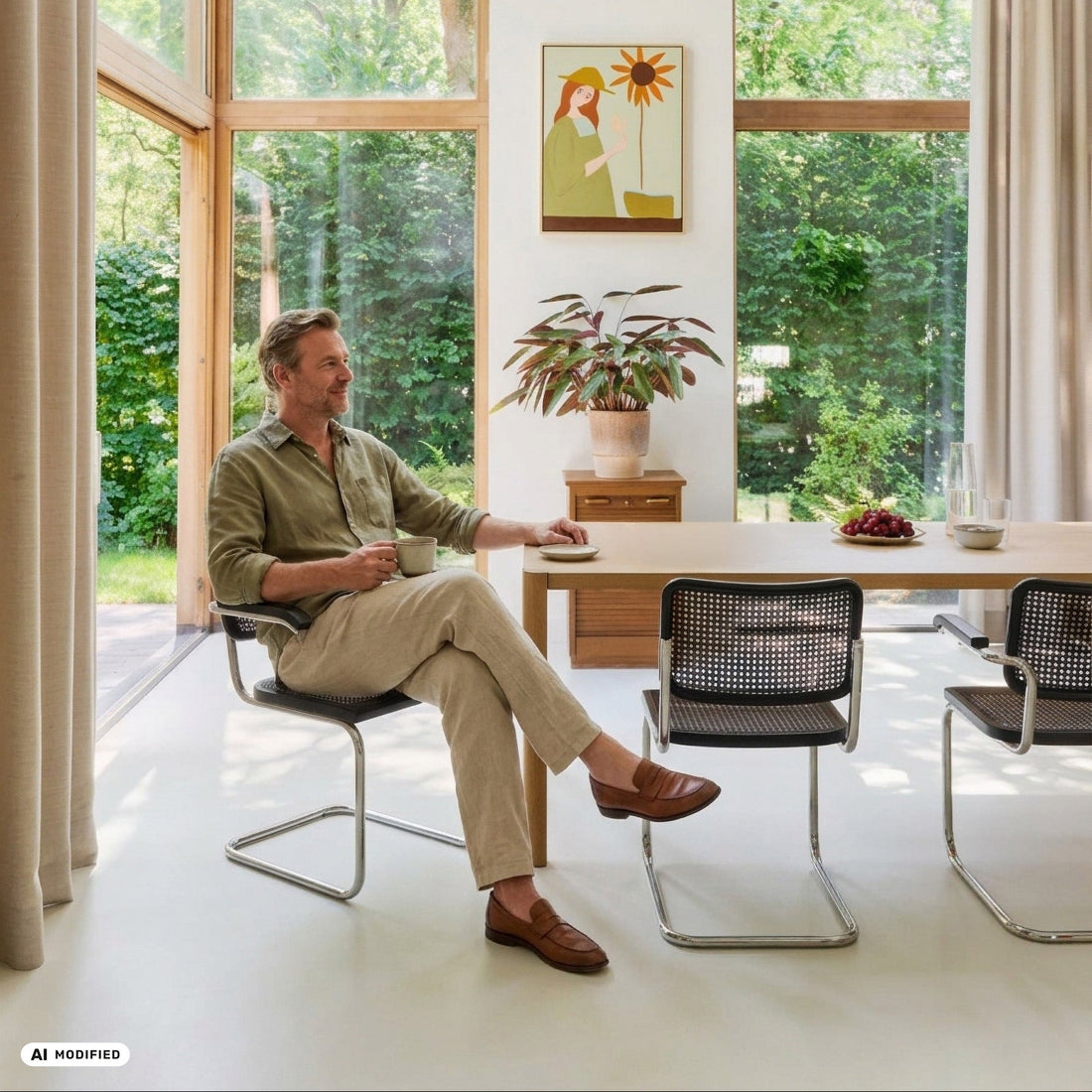
The cantilever chair is one of the most influential chair designs of the modern era. Unlike many archetypal pieces of furniture, its origins are clear: Mart Stam invented it in 1926. A century later, the cantilever chair is more than just a chair. It proves that great design happens when we stop thinking in old patterns.
The first cantilever chair also set a precedent in copyright law, ending in a surprising outcome. To mark its 100th anniversary, let's look at the fascinating story behind the design now known as the Thonet S 33/S 34.
1. Sitting, rocking, dangling your legs – this chair feels different
What seemed impossible became an icon. When the first tubular steel cantilever chair was designed in 1926 and presented a year later as part of the Werkbund exhibition, many people were sceptical: how could a chair without back legs support a person's weight?
But behind its apparently floating design was a clever idea: making deliberate use of steel's tensile strength and breaking boldly with everything furniture design had stood for until then.
Strictly speaking, the cantilever chair has no legs; the front of its frame is shaped into a loop. The frame curves backwards, giving the chair a stable base and a gentle spring.

The idea of designing a chair without back legs came from Mart Stam, who began experimenting with gas pipes in 1925. Those experiments led to the original cantilever chair as we know it today: the S 33.
2. A modern design milestone is born
But let's go back to the beginning.

Dutch architect Mart Stam is now regarded as a key figure of modernism. Like Walter Gropius and Ludwig Mies van der Rohe, he championed the principles of the Bauhaus. One of these was the democratisation of design – making good design affordable, for example through mass production.
Furniture should be affordable.
Perhaps that's why he began experimenting with gas pipes for his furniture designs: they were inexpensive and readily available. The result was a cantilever chair without back legs, with two fabric panels for the seat and back. With this archetypal cantilever design, Mart Stam reduced the materials and production required to a minimum.
You might think such an innovative idea would take the market by storm.
At first, it didn't.

Mart Stam wasn't the first designer to work with tubular steel. Marcel Breuer was also developing a tubular steel furniture range at the Bauhaus around the same time. Stam's chair without back legs inspired many of his contemporaries to create similar designs.
His cantilever chair was not an immediate bestseller, however. The design was too austere and the choice of materials too radical. Most people didn't want furniture with an industrial look in their homes. It seemed out of place among their oak furniture – between an Art Nouveau sideboard and a Biedermeier sofa.
3. The world's first copyright dispute over a piece of furniture

It took a while for the classic cantilever chair, model number B 33, now known as the Thonet S 33/S 34, to find its audience.
Even so, Stam believed in his design from the outset and secured copyright protection for it. This led to what was probably the first copyright dispute over a piece of furniture.
The parties were Mart Stam and Marcel Breuer. Both had transferred the rights to their tubular steel chairs to Anton Lorenz and Standard Möbel respectively. Thonet later acquired Standard Möbel.
In 1929, Thonet launched the cantilever chairs B 33 and B 34, crediting them to Marcel Breuer. The problem was that both chairs were formally identical to Mart Stam's design. A legal dispute followed between Lorenz and Thonet, and Breuer. The case passed through several courts before the Reichsgericht in Leipzig in Germany ruled in favour of the plaintiffs in 1932.
Thonet was no longer allowed to sell its chair as a design by Marcel Breuer.

Curiously, Anton Lorenz sold the rights he had just acquired to Thonet shortly afterwards. In addition, in 1961 the Federal Court of Justice awarded Mart Stam copyright in his cantilever chair design. This means that the design is protected as a work of applied art under German copyright law. That protection remains in place until 2056 – exactly 70 years after his death.
4. The legacy of the first cantilever chair
Despite the initial difficulties – which were probably down to the tastes of the time – and the legal disputes, Mart Stam's cantilever chair is now considered the archetype of its kind.
Cantilever chairs are popular today, partly because they're so comfortable. The controlled flex of a well-designed cantilever frame adapts to the sitter, offering a level of comfort that rigid chairs can't match.
The idea of a cantilevered chair, supported without four legs, has been revisited time and again. A number of iconic designs rely on the chair's springing structure – including the MR Chair by Mies van der Rohe, Gerrit Rietveld's Zig Zag Chair and, of course, the Panton Chair.
5. A new fabric for the cantilever chair's 100th anniversary

Thonet is celebrating 100 years of the cantilever chair with the new S 33 V/S 34 V. This Soft version returns to the fabric upholstery of the 1920s, when the chairs first appeared. Early tubular steel chairs were often covered in a fabric known as iron yarn. Despite its name, the fabric contained no iron; the term refers to its strength.
For the 100th anniversary of Mart Stam's chairs, Thonet is bringing back fabric upholstery as an alternative to classic core leather. The Soft version of Stam's cantilever chairs combines the clarity and structural logic of the original idea with the delight in colour and textiles that also defined the 1920s.
These chairs now tell a familiar story in a new way, showing that even icons can evolve. The clean proportions of the cubic chair feel almost feminine in the soft shades of the fabric upholstery – tactile and thoroughly inviting.
The Thonet S 33 V chair and the Thonet S 34 V, the armchair version, have a cosy look and offer even more comfort. Both work well at your dining table or desk, or as a chair in the bedroom or guest room.
And the cantilever chair proves that a 100-year-old classic can still delight us all over again.
6. What the history of the cantilever chair teaches us
So what can we learn from its story? True innovation takes courage – and it is invaluable. Mart Stam didn't simply build a piece of furniture; through persistent experimentation with materials that seemed unsuitable, he broke with centuries-old assumptions. We owe the design's status as an icon to his pioneering spirit. He created an entirely new design language that continues to inspire generations of designers.
At the same time, the story shows that a brilliant idea needs care. An icon stays relevant only when we continue to develop it thoughtfully.
That's exactly what Thonet does.
Through new materials, contemporary colours and textures, Thonet does more than preserve Mart Stam's legacy: it brings it into the present in the spirit of its creator.
The story teaches us that great design stands the test of time – provided we invest the passion and resources to keep falling in love with it all over again.